Abstract
We take a hard look at MDA and propose an expansion to it, in order to accommodate all games.
MDA and its legacy
It was almost twenty years ago today that Robin Hunicke, Marc LeBlanc, and Robert Zubeck taught us to play with a formal framework to game analysis: MDA — Mechanics, Dynamics, Aesthetics (Hunicke et al., 2004). The three levels are interconnected: Mechanics includes components and rules, Dynamics is the behavior of the game and its participants during play, and Aesthetics is the emotional response elicited by the game.
One of the feature elements from the original MDA paper is the idea that designer and player have opposing, complementary approaches to the game experience: the designer creates the mechanics, from which dynamics emerge, and which turn the game into an aesthetic experience for the player. Conversely, the player first becomes acquainted with the aesthetic qualities of a game, then she experiences its dynamic behavior, and thence she understands the underlying mechanics.
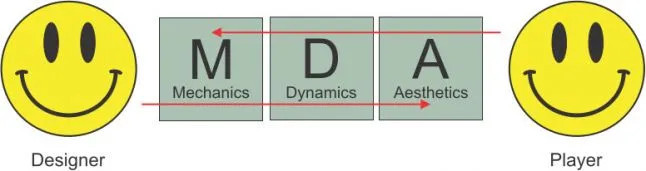
Orderly, linear progressions are as rare in games as in the natural world, and this is no exception. For instance, it is well-known that emergent behavior can indeed originate in the mechanics, as in Conway’s Game of Life; but especially as a result of participants’ ideas and actions, such as campers in the first multiplayer FPS games (Paez, 2020).
Even so, this scheme makes sense in many digital games — although not so much in multiplayer games, which perforce must deal with interplay between those pesky players.
But it falls apart in almost all non-digital games: a non-digital game cannot be played at all until at least one of the participants reads and understands its rules, often teaching them to other participants. In this case, the participants must approach a new game from its mechanics, and the dynamics will have to wait for at least a basic understanding of the rules before it can even exist.
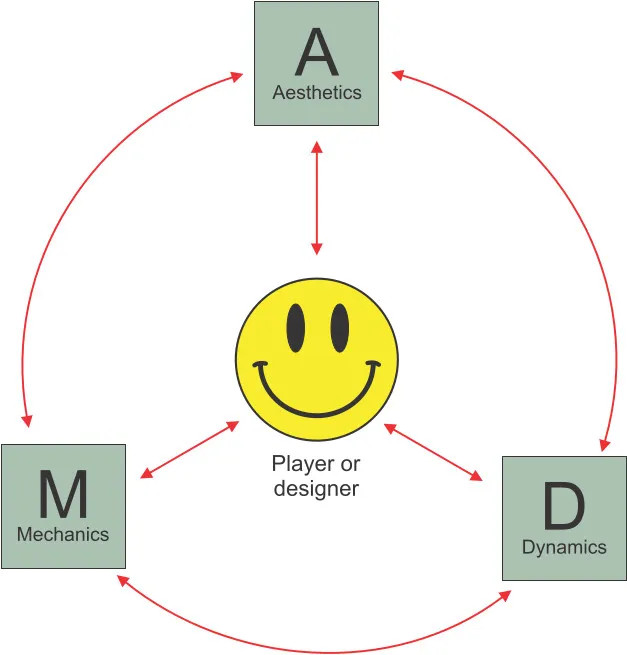
One of us (Duarte) has proposed an expansion of the original MDA concept, taking into account several interactions not contemplated in the original MDA paper (Duarte, 2015). Munhoz, then, further expanded this proposal, using concepts from Activity Theory (Munhoz, 2018). Recently, we have added to this mix the concept of rules agency (Duarte & Holanda, 2022).
In this paper, we first delve upon some key concepts from Activity Theory, and then proceed to explore how rules agency may be used as a defining element in the interactions of the expanded MDA framework.