Relevantes para a cladística de jogos:
. Jogos conhecidos de forma incompleta são exatamente análogos a registros biológicos fósseis.
. DFs são usadas como a base para as comparações cladísticas.
. Como eu escrevi no caso das DFs, a análise cladística deve indicar uma instância particular de um jogo e não pretender falar por todas as instâncias.
https://www.atlasobscura.com/articles/ancient-games-artificial-intelligence.amp
Links
https://metacpan.org/pod/Bio::Tree::Draw::Cladogram
http://pearl.cs.pusan.ac.kr/phylodraw/
http://www.cs.au.dk/~chili/Phyfi/about.html
http://www.lillo.org.ar/phylogeny/tnt/
Importante: https://en.wikipedia.org/wiki/Maximum_parsimony_(phylogenetics)
18xx publishing years
Game Year published
1829 1974
1830 1986
1853 1989
1881 1990
1835 1990
1870 1992
1847 1992
1842 1992
1839 1993
1899 1994
1841 1994
1837 1994
1856 1995
1825 1995
https://boardgamegeek.com/boardgamefamily/19/18xx
Game Phylogenetics: tracing a 18xx cladogram
Distinctive Features (DFs) have been proposed as the basis for a theoretical framework in game studies [@anon]. In this study, DFs are used to create a cladogram — a phylogenetics diagram — for some games of the 18xx board game family.
Game phylogenetics — that is, the study of the evolutionary history of games, tracing the often complex relationships between games — is still mainly in the descriptive stage. However, there are already a few steps towards phylogenetic systematization using cladograms (Goumagias et al., 2014).
In biology, cladograms are diagrams which showcase the relationships between groups of organisms, or clades. The relationships are inferred from shared characteristics between organisms which have a common ancestor. https://ucmp.berkeley.edu/clad/clad1.html
When tracing a cladogram, the relevant characteristics of the clades are described as binary features — for instance, the presence or absence of feathers. In this sense, the relevant characteristics of a clade are its DFs.
Indeed, a DF framework is a lexicon of categories, which represent characteristics of a phenomenon. DFs are binary, and the corresponding characteristic may be present {+} or absent {—} in a particular phenomenon [@anon].
In order to demonstrate the feasibility of a cladistic analysis in game studies, the 18xx board game family was chosen.^[Most games in the family have titles which begin with a year from the XIX century, thus the “18xx” name. But there are several games which do not follow the convention.]
Two different motives make the 18xx game family suitable as a test case here. First, all 18xx games are descended from a single common game, Francis Tresham’s 1829 (Hartland Trefoil, 1974), which is thus a common ancestor for this board game clade.
Furthermore, there already is a very handy comparison of several different characteristics between the 18xx games, the 18xx Rules Difference List (RDL). http://www.fwtwr.com/18xx/rules_difference_list/index.htm
Only binary characteristics from the RDL were selected. Although the 18xx game family has a few dozen games, only eight were selected, both from familiarity and because all of them had mentions in all of the selected RDL characteristics’ pages. This resulted in the DF matrix presented in Figure 1.
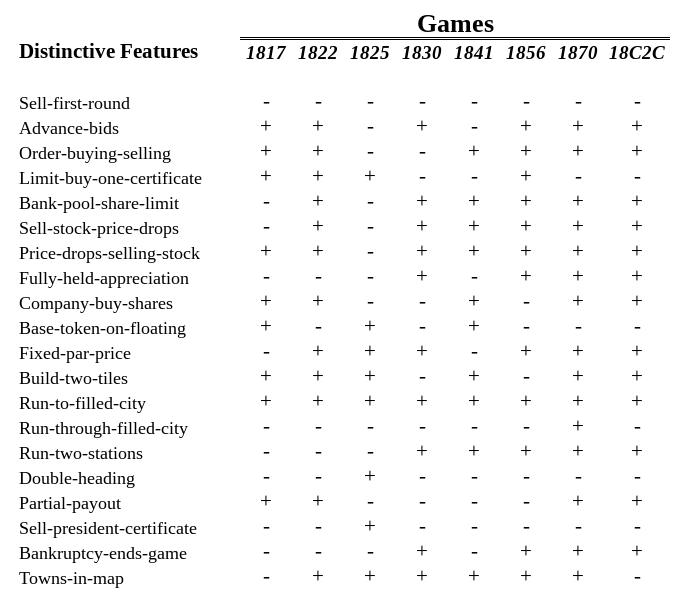
The DF set for the selected games.
The data in the DF matrix were used in the program Mesquite, htps://www.mesquiteproject.org/, which is used for phylogenetics analysis. The data in Figure 1 may originate several possible phylogenetic trees; one of the resulting cladograms is presented in Figure 2.
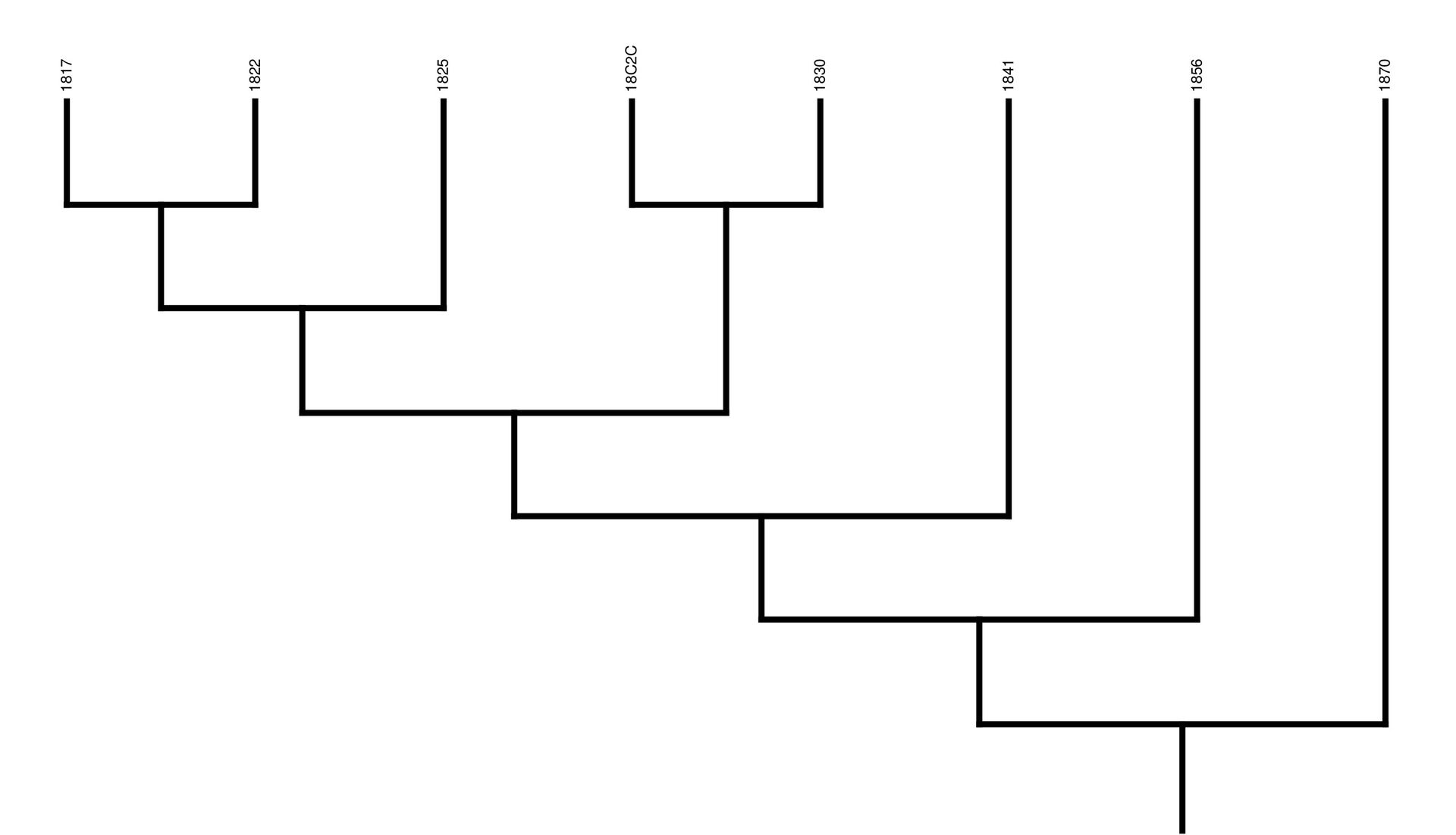
One of the cladograms created from the DF matrix data.
From Figure 2, several hypotheses about clades and relationships may be proposed. For instance, 1870 is a separate clade from all the other games in the data set; 1817 and 1822 are more closely related to 1825 than to 1841.
The data above derived from rules comparisons. When analyzing historical board games, most of the time the rules are not available. But the phylogenetic analysis sketched here also works with characteristics from the physical remains of board games.
A cladogram is not and end in itself, but only one more tool to be used in phylogenetics research — whether the phenomena being analyzed are living beings or games. In particular, the hypotheses resulting from phylogenetic analysis may suggest hitherto unimagined relationships between different games, which in turn may suggest common rules and mechanics.
Keywords: cladistics, phylogenetics, game studies, board games, 18xx