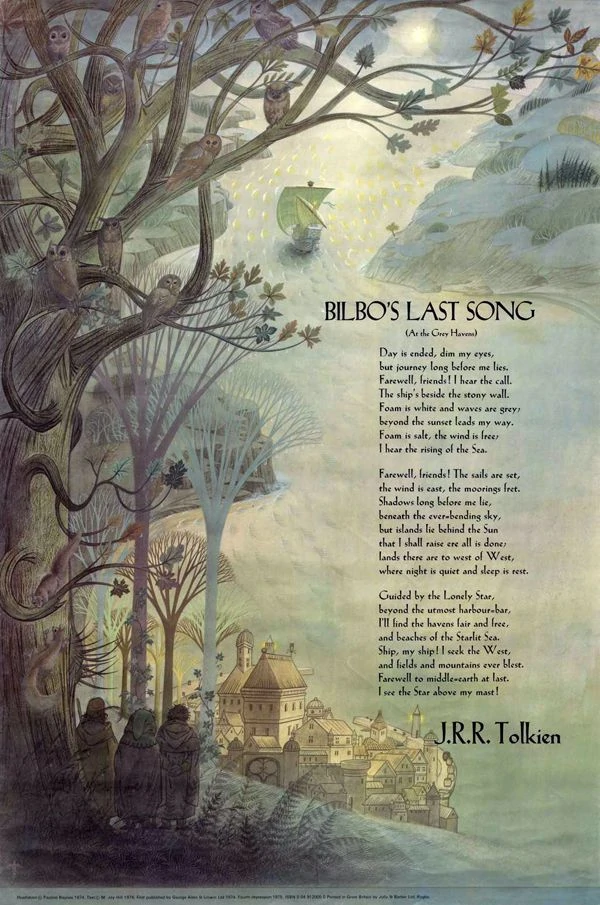
Bilbo’s last song
Day is ended, dim my eyes,
but journey long before me lies.
Farewell, friends! I hear the call.
The ship's beside the stony wall.
Foam is white and waves are grey;
beyond the sunset leads my way.
Foam is salt, the wind is free;
I hear the rising of the Sea.

Farewell, friends! The sails are set,
the wind is east, the moorings fret.
Shadows long before me lie,
beneath the ever-bending sky,
but islands lie behind the Sun
that I shall raise ere all is done;
lands there are to west of West,
where night is quiet and sleep is rest.

Guided by the Lonely Star,
beyond the utmost harbour-bar,
I'll find the heavens fair and free,
and beaches of the Starlit Sea.
Ship, my ship! I seek the West,
and fields and mountains ever blest.
Farewell to Middle-earth at last.
I see the Star above my mast!

-- J. R. R. Tolkien
For many years, Joy Hill served as secretary for J.R.R. Tolkien, and a close relationship they had. As the story goes, Professor Tolkien used to joke that, if ever a diamond bracelet were to fall out of an envelope of the correspondence she handled for him, it would be hers.
Near the end of Professor Tolkien’s life, as she helped him pack his office for a move, a poem Professor Tolkien had written fell out of a book. Ms. Hill read it, and fell in love with the short, three-verse piece; and Tolkien made it a gift to her, her “diamond bracelet”, so to speak.
Some time shortly later, after Professor Tolkien’s death in 1973, Ms. Hill gave the poem to the composer Donald Swann, who in 1967 had worked with Professor Tolkien himself to set many of Tolkien’s songs to music in the collection The Road Goes Ever On. Mr. Swann himself was so moved by the piece that he set it to music, and added it to the 2nd edition of the collection, which was published in 1978. The same poem was published as a poster in 1974, illustrated by Pauline Baynes, one of Tolkien’s favorite illustrators; and was included in the BBC audio production of the Lord of the Rings.
The poem does not itself actually appear in The Return of the King, the last volume of the The Lord of the Rings trilogy, but takes place at its very end, when many of the principal heroes of the War of the Ring prepare to set sail into the West, to leave Middle Earth forever: among them the great wizard Gandalf the White; Frodo Baggins, the great Ringbearer; and his elder Bilbo, who found the Ring so long before.
“Well, here at last, dear friends,” [said Gandalf], “on the shores of the Sea comes the end of our fellowship in Middle-earth. Go in peace! I will not say: do not weep; for not all tears are an evil.”
Then Frodo kissed Merry and Pippin, and last of all Sam, and went aboard; and the sails were drawn up, and the wind blew, and slowly the ship slipped away down the long grey firth; and the light of the glass of Galadriel that Frodo bore glimmered and was lost.
-- *The Return of the King*, chapter 9 "The Grey Havens"
The poem is Bilbo’s farewell to his friends and to Middle Earth, and in a sense, this poem is Tolkien’s farewell as well: to the Middle Earth he created, to the secretary who served him so faithfully; and to us, his readers, who came to cherish the world he created. But the poem’s depth and meaning still rings strong even for those who know nothing of Tolkien’s great masterpiece. The feelings Bilbo sings of are universal. In a few short lines Tolkien has for me, and so many others, captured perfectly the sorrow and hope alloyed together that make up all partings, from the ends of visits with beloved friends and family, to the final depature for mysteries unknown that all of us must one day face. And in that achievement, Tolkien demonstrates again the genius that has made him one of the greatest poets of this, or any, age.
Sources include the Foreword to the 2nd Edition (1978) of The Road Goes Ever On and On: A Song Cycle, by Donald Swann; and various Usenet and Internet sources, available upon request.
— Jeffrey Huo